
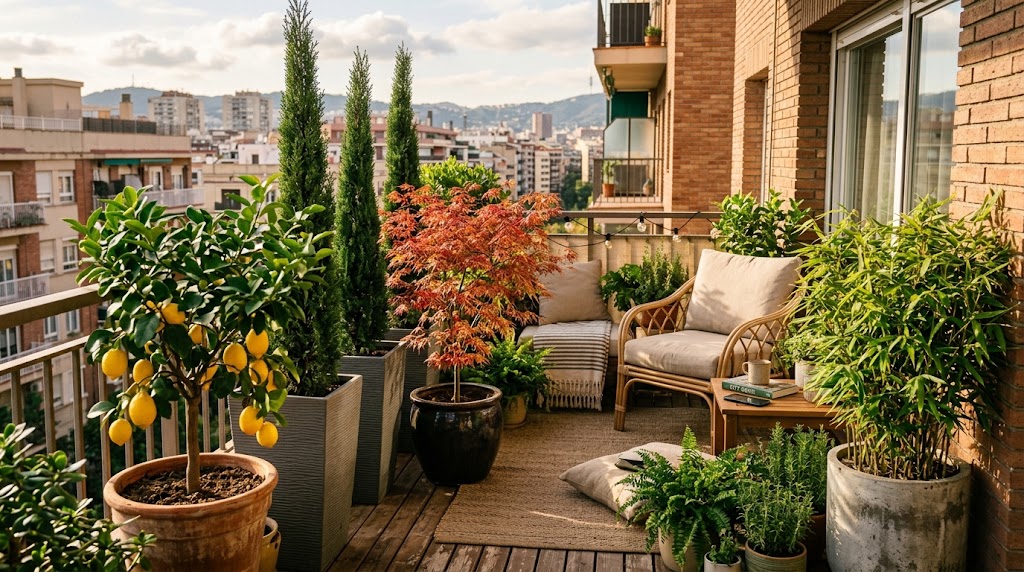
If you want to create a lush, natural green screen away from noisy neighbors, planting dwarf trees for balcony privacy is the ultimate container solution.
When I moved into my apartment, my balcony directly faced a busy apartment complex right across the street. Sitting outside to read a book or drink morning coffee felt like performing on a stage for my neighbors. I didn’t want to install ugly plastic blinds or heavy wooden fencing that blocked natural light and fresh air.
I quickly discovered that potted dwarf trees and patio shrubs create a stunning living privacy barrier. Compact tree varieties stay small enough to thrive in containers while offering dense foliage, sweet-smelling blossoms, and year-round green coverage.
According to container arboriculture guidelines from the University of Maryland Extension, dwarf tree rootstocks keep trees at 30 to 50 percent of their normal height, making them exceptionally stable and manageable in balcony containers.
Here is your complete guide to the 10 best dwarf trees for balcony privacy.
Why Growing Dwarf Trees for Balcony Privacy Works
Potted dwarf trees provide vertical height that low-growing flowers cannot match.
Selecting dwarf trees for balcony privacy blocks unwanted views, dampens urban street noise, provides natural shade during hot summer afternoons, and adds valuable architectural beauty to small outdoor spaces.

10 Best Dwarf Trees for Balcony Privacy Screens
Here are the top 10 dwarf tree species that excel in apartment containers.
1. Dwarf Italian Cypress (Cupressus sempervirens ‘Swane’s Gold’)
Dwarf Italian cypress grows in a sleek, narrow column that reaches 6 to 8 feet in large pots without spreading wide. It creates a formal Mediterranean green barrier without taking up floor space.
- Best For: Narrow balcony borders and corners.
- Sunlight Needs: 6+ hours of direct sun.
2. Dwarf Meyer Lemon Tree (Citrus × meyeri)
Meyer lemon trees produce glossy green leaves, fragrant white blossoms, and sweet edible lemons. Grouping two lemon trees along a railing creates a sweet-scented living screen.
- Best For: Sunny south-facing balconies.
- Sunlight Needs: 6 to 8 hours of sun.
3. Heavenly Bamboo (Nandina domestica ‘Gulf Stream’)
Nandina features delicate bamboo-like foliage that turns brilliant fiery red in autumn. It is dense, compact, and extremely resistant to breezy winds.
- Best For: Year-round foliage color and wind protection.
- Sunlight Needs: Full sun to partial shade.
4. Japanese Maple (Acer palmatum cultivars)
Dwarf Japanese maples offer breathtaking lacy foliage in shades of crimson, burgundy, and gold. Their wide branching habit provides wonderful side privacy.
- Best For: Shaded or east-facing apartment balconies.
- Sunlight Needs: Partial shade and shelter from harsh wind.
5. Dwarf Olive Tree (Olea europaea ‘Little Ollie’)
‘Little Ollie’ is a non-fruiting dwarf olive shrub with silver-green leaves. It is incredibly heat-tolerant, drought-resistant, and easily pruned into formal container hedges.
- Best For: Hot, dry south-facing patios.
- Sunlight Needs: 6+ hours of direct sun.
6. Emerald Green Arborvitae (Thuja occidentalis ‘Emerald Green’)
Arborvitae is a classic evergreen species with dense emerald foliage that stays green through cold winter months.
- Best For: Year-round privacy screens. Pair arborvitae with our guide on How to Create a Balcony Privacy Screen with Plants.
- Sunlight Needs: Full sun to partial sun.
7. Dwarf Alberta Spruce (Picea glauca ‘Conica’)
This slow-growing dwarf conifer forms a tight cone of soft green needles. It grows less than 2 to 4 inches per year, requiring zero pruning to maintain its neat shape.
- Best For: Extremely cold winter balconies.
- Sunlight Needs: Full sun.
8. Camellia (Camellia japonica)
Camellias feature thick, glossy evergreen leaves topped with large rose-like blossoms in late winter and early spring when other plants are dormant.
- Best For: Shaded north-facing or east-facing balconies.
- Sunlight Needs: Morning sun and afternoon shade.
9. Dwarf Fig Tree (Ficus carica ‘Little Miss Figgy’)
‘Little Miss Figgy’ stays under 4 feet tall in containers while producing deeply lobed leaves and delicious sweet figs in late summer.
- Best For: Compact edible privacy screens.
- Sunlight Needs: 6 hours of sunlight.
10. Boxwood Hedges (Buxus microphylla)
Dwarf boxwoods can be sheared into dense geometric green walls. Their thick evergreen branches create an impenetrable barrier against wind and prying eyes.
- Best For: Formal perimeter hedging.
Care Tips for Dwarf Trees for Balcony Privacy Containers
To keep your potted trees healthy and stable on high-rise patios, follow these essential care rules:
- Use Heavy Planters: High winds can tip tall potted trees. Choose heavy glazed ceramic or resin planters with wide bases, or place heavy river rocks at the bottom of containers.
- Prune Annually: Prune leading branches in early spring to encourage dense interior foliage and keep tree heights manageable.
- Protect in Winter: Move potted trees against interior walls during freezing months to protect container root zones.
Tree care research from the Royal Horticultural Society (RHS) recommends choosing wide containers at least 16 to 20 inches in diameter to accommodate expanding dwarf tree root systems.
If your balcony experiences high gusts, discover durable varieties in our guide on 10 Best Wind Tolerant Balcony Plants for High-Rise Patios.
For smart pot arrangements, check out our 10 Best Balcony Plant Layout Ideas for Small Spaces.
Recommended Related Reading 📚
To continue building your private urban oasis, explore these related guides on our website:
- 🛡️ How to Create a Balcony Privacy Screen with Plants – Complete guide to patio privacy screens.
- 💨 10 Best Wind Tolerant Balcony Plants for High-Rise Patios – Wind-hardy plants for high balconies.
- 📐 10 Best Balcony Plant Layout Ideas for Small Spaces – Smart container layout designs for small spaces.
Frequently Asked Questions
How big of a pot does a dwarf tree need on a balcony?
Dwarf trees require pots at least 16 to 24 inches wide and deep (10-gallon to 15-gallon capacity) with large bottom drainage holes to allow healthy root expansion.
Can dwarf trees stay outdoors on a balcony all winter?
Hardy evergreens (like arborvitae, dwarf spruce, and boxwood) can stay outdoors if their pots are insulated with burlap and grouped against building walls. Subtropical trees (like lemons and figs) must be protected from freezing frost.
Final Thoughts
You do not need a suburban backyard to enjoy the beauty and shade of real trees. By planting dwarf cypress, Meyer lemon, Japanese maple, and arborvitae, you can easily grow dwarf trees for balcony privacy and enjoy a secluded outdoor sanctuary.
Which dwarf tree will you plant on your balcony first? Tell us in the comments below!