

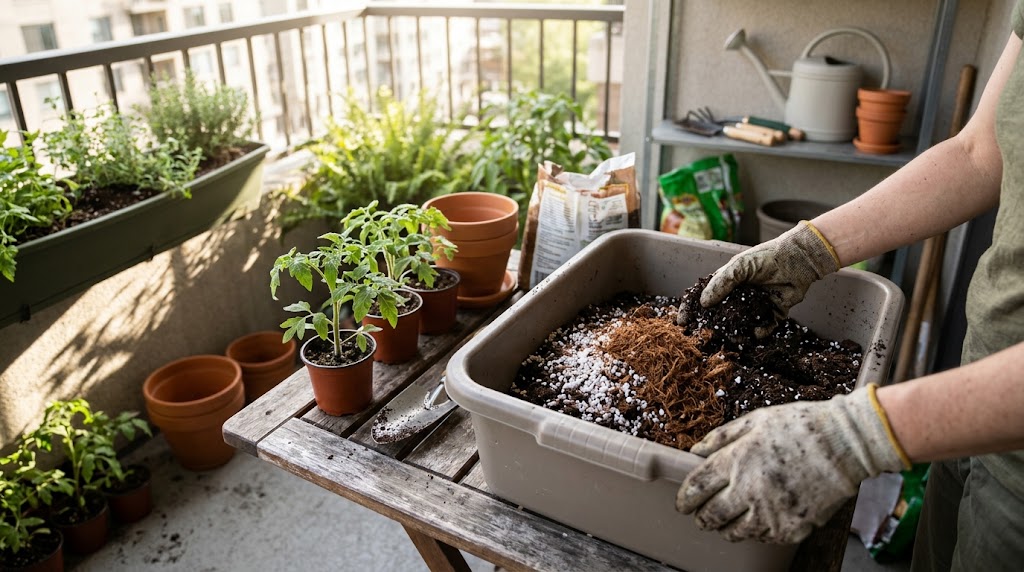
If you want to grow lush, heavy-yielding container crops that never suffer from root rot or nutrient starvation, choosing the best potting soil for balcony vegetables is an easy, foundational decision.
When I first started balcony gardening, my biggest mistake happened before I even planted a single seed. To save money, I bought three bags of cheap “topsoil” and “garden dirt” from a local hardware store, dumped it into my containers, and planted cherry tomatoes and sweet peppers. Within three weeks, my balcony garden was an absolute disaster. Whenever it rained, the dense dirt turned into heavy, suffocating mud that refused to drain. During hot summer afternoons, that same dirt baked into rock-hard gray bricks that shrank away from the container edges, strangling my seedlings’ roots.
That painful failure taught me the most important lesson in container gardening: container pots are completely different biological environments than in-ground garden beds.
In a backyard garden, natural earthworms, subterranean burrowing insects, and continuous deep ground layers provide natural drainage channels. But inside a closed container on an apartment balcony, gravity pulls water down into the bottom third of the pot, creating what soil scientists call a “perched water table.” If your potting medium is too dense, root tips drown in stagnant, oxygen-depleted mud.
By using a fluffy, well-aerated, and nutrient-dense growing mix, your potted vegetables can develop massive fibrous root systems that fuel rapid growth and bountiful harvests all summer long.
According to soil science research from the University of Minnesota Extension, containerized crops require a specialized soilless potting substrate containing at least 20 percent macro-pore space for continuous root oxygenation, which ordinary in-ground garden soil simply cannot provide.
Here is your complete, bookmark-worthy guide to mastering the best potting soil for balcony vegetables.
Why Choosing the Best Potting Soil for Balcony Vegetables Matters
Potted vegetables have access to only the small volume of soil inside their containers to draw every drop of water and nutrient they need.
Selecting the right potting soil for balcony vegetables guarantees instant drainage during downpours, locks in capillary moisture during heatwaves, prevents soil-borne fungal blights, and keeps container weights safe for apartment balcony building limits.

The 4 Core Building Blocks of High-Performance Balcony Soil
Every successful recipe for potting soil for balcony vegetables relies on four essential components blended in precise scientific harmony.
1. The Moisture-Holding Base (Peat Moss or Coconut Coir)
The structural base of container soil must hold moisture like a sponge without turning into sludge.
- Coconut Coir (Recommended): Made from fibrous coconut husks, coir is a sustainable, pH-neutral (6.0 to 6.8) alternative to peat. It re-wets effortlessly even if allowed to dry out completely.
- Sphagnum Peat Moss: Classic, lightweight, and sterile. Peat holds up to ten times its weight in water, though it has an acidic pH (3.5 to 4.5) that requires balancing with garden lime.
2. The Aeration & Drainage Engine (Perlite or Pumice)
Roots cannot absorb water or food without dissolved oxygen. Aeration amendments create thousands of microscopic air pockets throughout the root zone.
- Horticultural Perlite: Volcanic glass popped under intense heat into lightweight white sterile kernels. Perlite ensures water drains freely out of bottom holes while keeping container soil fluffy.
- Horticultural Pumice: Slightly heavier than perlite, volcanic pumice will not float to the soil surface over time and provides excellent weight stability on windy balconies.
3. The Organic Fuel (Compost & Worm Castings)
Soilless bases contain zero natural fertility. Organic compost introduces millions of beneficial microscopic bacteria and mycorrhizal fungi that break down nutrients.
- Aged Leaf & Vegetable Compost: Rich in organic carbon, humic acids, and slow-release nitrogen.
- Earthworm Castings (“Black Gold”): The finest, gentlest organic amendment on earth. Worm castings will never burn tender roots and provide a biological shield against soil-borne pathogens.
4. Mineral & Nutrient Boosters (Slow-Release Organic Meals)
To fuel heavy-feeding crops like container tomatoes, peppers, and cucumbers, blend in balanced organic amendments:
- Dolomite Lime: Buffers acidity and supplies vital calcium and magnesium (preventing blossom end rot).
- Bone Meal / Rock Phosphate: Fuels deep root expansion and heavy floral bloom sets.
- Kelp Meal: Delivers trace ocean minerals, potassium, and natural plant growth hormones.
5 Easy & Proven Recipes for Potting Soil for Balcony Vegetables
Depending on what you want to grow on your apartment patio, use these tested DIY recipes to blend the perfect potting mix at home.
Recipe 1: The All-Purpose Heavy-Feeder Blend (Best for Tomatoes, Peppers & Cucumbers)
Heavy-feeding fruiting vegetables require deep moisture retention, structural stability, and rich calcium reserves to produce sweet, firm fruit.
- 40% Coconut Coir or Peat Moss (hydrated)
- 30% Well-Aged Organic Compost
- 20% Coarse Horticultural Perlite
- 10% Earthworm Castings
- Additions (per 5 gallons of mix): 1/2 cup organic all-purpose 4-4-4 vegetable fertilizer, 1/4 cup bone meal, and 2 tablespoons dolomite lime.
- Best Paired With: Container tomatoes and peppers! Check out our container tips in 10 Best Small Space Balcony Vegetables.
Recipe 2: The Ultra-Lightweight High-Drainage Mix (Best for Grow Bags & Railing Boxes)
Fabric grow bags and hanging railing boxes dry out quickly and require ultra-breathable mixes that maximize air-pruning.
- 50% Coconut Coir
- 30% Coarse Perlite or Pumice
- 20% Earthworm Castings
- Additions: 1/4 cup organic seaweed kelp meal and 1/4 cup slow-release organic plant food.
- Why It Excels: Weighs half as much as standard soil blends, making it ideal for high-rise weight limits. Explore grow bag gardening in 10 Best Grow Bags for Balcony Vegetables.
Recipe 3: The Moisture-Retentive Leafy Greens & Salad Mix (Best for Spinach, Lettuce & Herbs)
Shallow-rooted salad crops and tender herbs need constant, even moisture so leaves stay sweet, tender, and crisp without bolting.
- 50% Peat Moss or Coconut Coir
- 25% Organic Compost
- 15% Vermiculite (spongy mineral flakes that hold water longer than perlite)
- 10% Coarse Perlite
- Additions: 2 tablespoons blood meal (gentle organic nitrogen boost for rapid leaf growth).
Recipe 4: The Deep-Root Mix for Balcony Carrots, Radishes & Beets
Root crops need loose, completely stone-free soil so taproots can expand straight down without forking or stunting.
- 50% Sifted Peat Moss or Fine Coco Coir
- 30% Coarse Perlite
- 20% Finely Sifted Worm Castings
- Golden Rule: Avoid adding excess nitrogen fertilizer, which causes root vegetables to grow massive leafy green tops while leaving tiny, stunted roots below!
Recipe 5: The Acid-Loving Berry & Small Fruit Blend (Best for Balcony Blueberries)
Blueberries and acid-loving small fruits will turn yellow and die in standard neutral soil. They demand a specialized acidic pH between 4.5 and 5.5.
- 50% Sphagnum Peat Moss (naturally acidic)
- 30% Aged Fine Pine Bark Mulch or Azalea Mix
- 20% Coarse Perlite
- Additions: 1 tablespoon elemental soil sulfur per 5 gallons of mix to lock in acidity. Pair with cultivars from 10 Best Blueberry Varieties for Balcony Containers.
Balcony Potting Soil Recipe Matrix
Use this quick-reference table to choose or blend the ideal potting mix for your specific balcony crops:
| Soil Recipe Style | Primary Ingredients | Drainage Speed | Moisture Retention | Target Vegetable Crops | Balcony Weight Profile |
|---|---|---|---|---|---|
| All-Purpose Fruiting | Coir + Compost + Perlite + Worm Castings | Fast & Free | ⭐⭐⭐⭐ High | Tomatoes, Peppers, Eggplants, Squash | Moderate Weight |
| Lightweight Aeration | Coir (50%) + Perlite (30%) + Castings | Ultra-Fast | ⭐⭐⭐ Moderate | Grow Bags, Railing Planters, Troughs | Ultra-Lightweight |
| Moisture-Retentive | Coir + Compost + Vermiculite + Perlite | Moderate | ⭐⭐⭐⭐⭐ Maximum | Lettuce, Spinach, Chard, Parsley | Moderate to Heavy |
| Loose Root Blend | Sifted Coir + Fine Perlite + Castings | Rapid | ⭐⭐⭐ Moderate | Carrots, Radishes, Beets, Scallions | Lightweight |
| Acidic Berry Mix | Peat Moss (50%) + Pine Bark + Perlite | Fast | ⭐⭐⭐⭐ High | Blueberries, Strawberries, Cranberries | Lightweight |
How to Rejuvenate and Reuse Old Potting Soil for Balcony Vegetables
One of the greatest myths in apartment gardening is that you must throw away all your container soil and buy expensive new bags every single spring. Discarding dozens of gallons of potting soil is expensive, wasteful, and exhausting for apartment dwellers without backyards.
The structural base of your soil (the coconut coir and perlite) lasts for three to five years before breaking down. Only the organic nutrients and beneficial microbes become depleted.
Follow this easy 4-step process to safely revitalize your old potting soil for balcony vegetables every spring:
1. Dump and Sift Out Dead Roots
Empty your old container pots into a large plastic storage bin. Use a hand fork or garden riddle to sift out thick dead roots, tomato vine stalks, and leftover debris.
2. Solarize the Soil (Natural Sanitization)
If your plants suffered from fungal blights or aphids the previous year, spread the old mix onto a clean tarp in full sun, moisten it lightly, and cover it with clear plastic sheeting for three sunny days. Trapped solar heat reaches over 120°F (49°C), pasteurizing the mix and killing insect eggs, weed seeds, and harmful fungal spores.
3. Replenish Organic Matter (The 70/30 Rule)
Add 30 percent fresh organic matter to your 70 percent rejuvenated old soil. Blend in 2 parts fresh organic leaf compost and 1 part pure earthworm castings to re-introduce living beneficial microbes.
4. Re-Mineralize with Organic Nutrients
Mix in 1/2 cup of balanced organic vegetable fertilizer, 2 tablespoons of bone meal, and 2 tablespoons of dolomite lime per 5 gallons of rejuvenated soil. Your recycled mix will now be even richer, darker, and more biologically active than a brand-new store-bought bag!
Waste reduction research from the Cornell Waste Management Institute confirms that replenishing weathered container media with 25 to 30 percent fresh biologically active compost restores soil cation exchange capacity (CEC) to prime levels.
For moisture management tricks once your pots are filled, read our guide on How to Prevent Container Soil Drying Out Fast.
If you want to make your own free soil amendments at home, check out our tutorial on How to Build a Balcony Compost Bin for Small Apartments.
Recommended Related Reading 📚
To continue building a thriving container vegetable garden on your apartment patio, explore these related guides on our website:
- 🪴 10 Best Grow Bags for Balcony Vegetables – Maximize root aeration and space with fabric containers.
- 💧 How to Prevent Container Soil Drying Out Fast – Master soil moisture balance and stop hydrophobic crusting.
- 🥗 10 Best Small Space Balcony Vegetables for Apartments – High-yield compact vegetables for small pots.
Frequently Asked Questions About Potting Soil for Balcony Vegetables
Can I mix garden topsoil into my balcony pots to save money?
No! Ordinary garden soil contains heavy clay, silt, weed seeds, and fungal pathogens. When placed inside a container, garden soil compacts into dense mud that suffocates roots and drowns container plants. Always use a lightweight, porous potting mix.
What is the myth of putting gravel or rocks at the bottom of pots?
For decades, gardeners believed adding a layer of gravel at the bottom of pots improved drainage. Modern horticultural science proves this is false: gravel actually raises the “perched water table,” forcing saturated muddy soil higher up into your plant’s root ball. Use uniform potting mix from the top of the pot all the way to the drainage holes.
How do I know if my potting soil has become hydrophobic?
If water immediately pools on top of the soil and runs straight down the inside edges of the pot while the center root ball remains bone-dry, your soil has become hydrophobic. Place the entire pot in a tub of water for twenty minutes so moisture wicks up from the bottom to rehydrate the peat core.
Final Thoughts
The secret to harvesting baskets of sweet, juicy balcony vegetables isn’t fancy gadgets or expensive plant food—it all begins with the soil beneath your seeds. By blending high-quality coconut coir, perlite, organic compost, and worm castings, you can easily create the best potting soil for balcony vegetables and enjoy thriving, productive container crops all season long.
Make sure to bookmark this recipe guide before mixing your spring container pots!
Which vegetable soil mix will you blend on your apartment balcony this season? Share your soil questions and container setups in the comments below!