

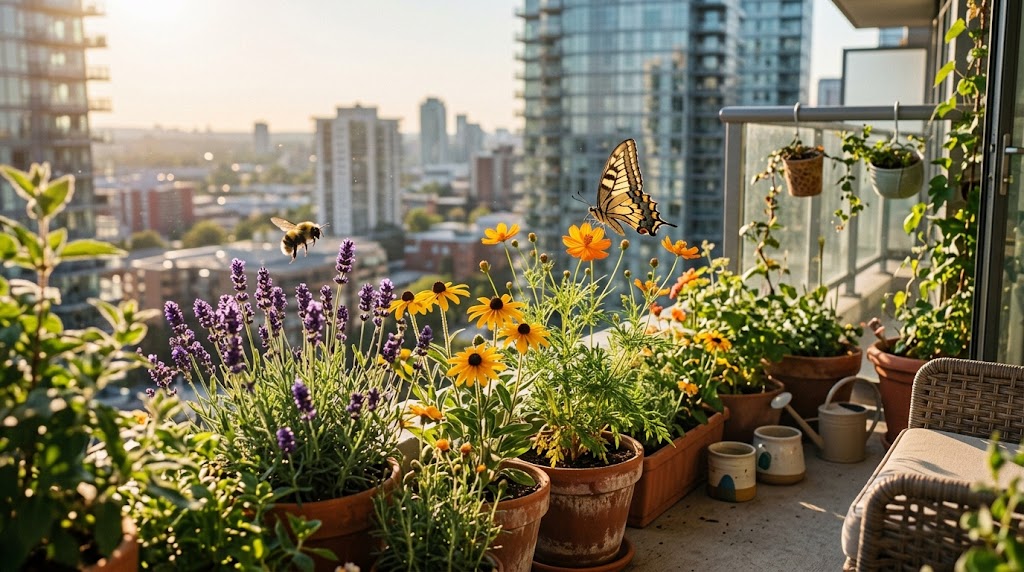
If you want to attract friendly bees, colorful butterflies, and beneficial hoverflies to your high-rise patio, choosing the best pollinator plants for apartment balconies is an easy, rewarding project.
When I first started growing container vegetables on my third-floor apartment balcony, I noticed a frustrating pattern. My potted tomatoes, cucumbers, and strawberries produced dozens of bright yellow flower blossoms, but after a week, the unpollinated flowers simply dried up and dropped off without setting any fruit. Because high-rise balconies are isolated from ground-level gardens, visiting bees and butterflies rarely flew up to inspect my patio.
I quickly learned that urban apartment balconies lack visual floral beacons. If you only grow leafy greens or green vegetable vines, passing pollinators fly right past your building. By intentionally dedicating a few pots and railing boxes to nectar-rich, colorful blooms, you create an irresistible aerial stepping stone for native pollinators.
Bringing pollinators to your balcony does far more than just look pretty. Visiting bees cross-pollinate your container vegetables, multiplying your harvests of tomatoes, squash, and berries. Furthermore, nectar-rich flowers attract beneficial predatory insects like lacewings and hoverflies whose larvae feast on aphids and spider mites, providing free organic pest management.
According to urban ecology research from the University of California Agriculture and Natural Resources (UC ANR), high-rise container plantings above the third floor experience a 45 percent increase in fruit set when paired with nectar-dense companion flowers compared to isolated vegetable planters.
Here is your complete, bookmark-worthy guide to the 10 best pollinator plants for apartment balconies.
Why Planting Pollinator Plants for Apartment Balconies is Crucial
Urban environments feature vast concrete surfaces with limited nectar sources for declining native bee and butterfly populations.
Selecting pollinator plants for apartment balconies turns underutilized high-rise ledges into vital wildlife corridors, dramatically boosts vegetable fruit set, and brings the soothing, joyful sight of fluttering butterflies and humming bees right outside your patio glass door.

10 Best Pollinator Plants for Apartment Balconies
Here are the top 10 flowering species that thrive in containers and attract the widest variety of beneficial pollinators.
1. English Lavender (Lavandula angustifolia)
Lavender is universally considered the crown jewel of pollinator plants for apartment balconies. Its aromatic purple flower spikes are loaded with high-sugar nectar that attracts bumblebees, honeybees, and butterflies throughout summer.
- Primary Pollinators: Bumblebees, honeybees, and swallowtail butterflies.
- Sunlight Needs: 6+ hours of direct sun.
- Container Tip: Use porous terracotta pots with fast-draining cactus or perlite-rich soil. Pair with favorites from our guide on 10 Best Fragrant Balcony Plants for a Sweet Patio.
2. Purple Coneflower (Echinacea purpurea)
Echinacea features striking magenta petals surrounding a prominent spiky central cone packed with rich nectar and pollen. It handles container life, summer heatwaves, and windy balconies effortlessly.
- Primary Pollinators: Native solitary bees, honeybees, and monarch butterflies.
- Sunlight Needs: Full sun.
- Container Tip: Deep 12-inch pots allow its taproot to establish strong perennial roots.
3. Sweet Alyssum (Lobularia maritima)
Sweet alyssum produces cascading clouds of tiny white and violet blossoms that release a heavenly honey fragrance.
- Primary Pollinators: Micro-pollinators, parasitic wasps, and hoverflies (which devour garden aphids!).
- Sunlight Needs: Full sun to partial shade.
- Container Tip: Tuck along the outer rims of railing boxes to spill over edges.
4. Borage / Starflower (Borago officinalis)
Borage is famous for refilling its bright blue star-shaped blossoms with fresh nectar every two to three minutes, keeping pollinating bees visiting your balcony all day long.
- Primary Pollinators: Honeybees and bumblebees.
- Sunlight Needs: Full sun to light morning shade.
- Vegetable Pairing: Plant near tomatoes and peppers. Explore our companion guide on 10 Best Companion Plants for Balcony Tomatoes.
5. Mexican Bush Sage (Salvia leucantha)
Salvias are hummingbird and bee magnets. Mexican bush sage produces velvety purple and white flower spikes that bloom continuously from mid-summer until late autumn.
- Primary Pollinators: Hummingbirds, native bees, and large butterflies.
- Sunlight Needs: 6 hours of sunlight.
- Container Tip: Extremely drought-tolerant once established in 3- to 5-gallon pots.
6. Black-Eyed Susan (Rudbeckia hirta)
Golden yellow daisy petals with dark chocolate button centers act as landing pads for visiting butterflies and bees looking for late-season pollen.
- Primary Pollinators: Butterflies and native leafcutter bees.
- Sunlight Needs: Full direct sun.
- Container Tip: Pairs wonderfully with ornamental grasses in mixed patio tubs.
7. Cosmos (Cosmos bipinnatus)
Cosmos produce delicate, feathery foliage topped with open, saucer-shaped blossoms in shades of pink, white, and magenta that allow easy access for short-tongued beneficial insects.
- Primary Pollinators: Hoverflies, solitary bees, and butterflies.
- Sunlight Needs: Full sun.
- Container Tip: Grows rapidly from seed in shallow rectangular troughs.
8. Anise Hyssop (Agastache foeniculum)
Anise hyssop features dense cylindrical spikes of lavender-blue flowers that smell like sweet black licorice. In trial gardens, it consistently ranks among the top three nectar plants for native bees.
- Primary Pollinators: Native bees, bumblebees, and clearwing moths.
- Sunlight Needs: Full sun to light afternoon shade.
- Container Tip: Pest-resistant and virtually maintenance-free.
9. Zinnia (Zinnia elegans – Single-Flowered Cultivars)
Brightly colored dwarf zinnias in hot pink, fiery orange, and bright red provide vibrant color for your balcony while serving as prime butterfly fueling stations.
- Primary Pollinators: Monarch, painted lady, and swallowtail butterflies.
- Sunlight Needs: 6+ hours of intense sun.
- Important Note: Choose single-flowered varieties (like ‘Profusion’ or ‘Zahara’) where central pollen discs are accessible, rather than tight double-ruffled varieties.
10. Catmint (Nepeta racemosa ‘Walker’s Low’)
Catmint produces low billowing mounds of gray-green aromatic foliage smothered in lavender-blue blooms from May through September. It is rugged, drought-proof, and loved by bees.
- Primary Pollinators: Honeybees and bumblebees.
- Sunlight Needs: Full sun to partial shade.
- Container Tip: Prune back lightly after the first summer bloom flush to trigger a second heavy wave of autumn flowers. Pair with picks from 10 Best Low Maintenance Balcony Plants.
Balcony Pollinator Plant Performance Matrix
Use this quick-reference table to design a continuous bloom sequence that feeds pollinators across every season:
| Plant Name | Primary Pollinators | Bloom Season | Minimum Pot Depth | Sun Requirement | Drought Tolerance |
|---|---|---|---|---|---|
| English Lavender | Bumblebees & Honeybees | Late Spring–Mid Summer | 10 Inches | 6+ Hours Direct Sun | ⭐⭐⭐⭐⭐ Exceptional |
| Purple Coneflower | Native Bees & Butterflies | Mid Summer–Late Autumn | 12 Inches | Full Sun | ⭐⭐⭐⭐ High |
| Sweet Alyssum | Hoverflies & Micro-Wasps | Spring–Late Frost | 6 Inches | Sun to Part Shade | ⭐⭐⭐ Moderate |
| Borage | Honeybees & Bumblebees | Spring–Mid Summer | 8–10 Inches | Full Sun to Morning Sun | ⭐⭐⭐ Moderate |
| Mexican Sage | Hummingbirds & Bees | Mid Summer–Autumn Frost | 12 Inches | Full Sun | ⭐⭐⭐⭐⭐ Exceptional |
| Black-Eyed Susan | Butterflies & Native Bees | Summer–Autumn | 10 Inches | Full Sun | ⭐⭐⭐⭐ High |
| Cosmos | Butterflies & Hoverflies | Early Summer–Frost | 8 Inches | Full Sun | ⭐⭐⭐⭐ High |
| Anise Hyssop | Native Solitary Bees | Summer–Autumn | 10 Inches | Sun to Part Shade | ⭐⭐⭐⭐ High |
| Dwarf Zinnias | Monarchs & Butterflies | Summer–Autumn | 8 Inches | Full Direct Sun | ⭐⭐⭐ Moderate |
| Catmint | Honeybees & Bumblebees | Late Spring–Autumn | 8–10 Inches | Sun to Part Shade | ⭐⭐⭐⭐⭐ Exceptional |
How to Design and Maintain Pollinator Plants for Apartment Balconies
To turn your balcony into an active urban pollinator oasis, follow these four essential habitat rules:
1. Plant in Visual Color Clustered Blocks
Bees and butterflies navigate urban canyons using visual color cues. Instead of scattering single isolated pots across your patio, group three or four pots of the same flower color together (for example, clustering purple lavender next to purple catmint). Clustered floral color blocks are visible from much greater distances in the sky.
2. Plan a Continuous Four-Season Bloom Calendar
Pollinators require energy from early spring emergence until late autumn migration. Combine early spring bloomers (Sweet Alyssum and Borage) with midsummer favorites (Lavender and Zinnias) and late autumn bloomers (Coneflowers and Mexican Sage) so your balcony offers an unbroken food supply.
3. Add a Shallow Balcony Bee Watering Station
Flying takes tremendous energy, and hardworking bees often suffer from dehydration on hot urban balconies. Set out a shallow terracotta saucer filled with clean river pebbles or decorative glass marbles, and fill it with water just halfway up the stones. The pebbles provide safe, dry perches so bees and butterflies can drink without risk of drowning.
4. Commit to 100% Pesticide-Free Gardening
Never use synthetic chemical insecticides or systemic neonics on your balcony garden. Even small chemical residues can paralyze or disorient visiting bees. Instead, use natural water blasts, insecticidal soaps, and beneficial predatory insects. Review our safe recipes in 10 Best Organic Pest Control Methods for Balcony Plants.
Pollinator conservation research from the Royal Horticultural Society (RHS) emphasizes choosing single, open-faced flower cultivars over heavily hybridized double blooms, as double petals physically block pollinators from reaching underlying nectar glands.
Recommended Related Reading 📚
To continue transforming your apartment patio into a lush, biodiverse haven, explore these related guides on our website:
- 🌸 10 Best Fragrant Balcony Plants for a Sweet Patio – Scented container flowers that perfume your outdoor space.
- 🍅 10 Best Companion Plants for Balcony Tomatoes – Boost fruit set and naturally deter tomato pests.
- 🌿 10 Best Low Maintenance Balcony Plants for Beginners – Stress-free, durable plants for busy urban gardeners.
Frequently Asked Questions About Pollinator Plants for Apartment Balconies
Will attracting bees to my apartment balcony cause painful stings?
No! Foraging bees visiting flowers for nectar and pollen are completely docile. Unlike aggressive meat-seeking wasps or hornets defending a nest, bees on flowers will ignore humans unless physically crushed. You can safely sit inches away from blooming lavender and watch them work peacefully.
Can pollinators really reach balconies on the 5th or 10th floor?
Yes! While pollinator density is highest near ground level, foraging honeybees, bumblebees, hoverflies, and strong-flying butterflies (like Monarchs and Swallowtails) regularly ascend to the 10th floor and beyond when lured by high-contrast floral colors and fragrant scents.
Which flower colors attract the most pollinators?
Bees have ultraviolet photoreceptors and are naturally drawn to blue, purple, violet, yellow, and white blossoms. Hummingbirds and butterflies, on the other hand, are exceptionally attracted to vivid red, orange, and hot pink tubular flowers.
Final Thoughts
You don’t need a sprawling suburban wildflower meadow to make a real difference for native bees and butterflies. By planting lavender, coneflowers, borage, and salvias, you can easily cultivate pollinator plants for apartment balconies and enjoy a buzzing, thriving green haven right outside your window.
Make sure to bookmark this guide for your spring and summer planting plans!
Which pollinator flower are you most excited to add to your balcony garden this season? Share your thoughts and patio setups in the comments below!